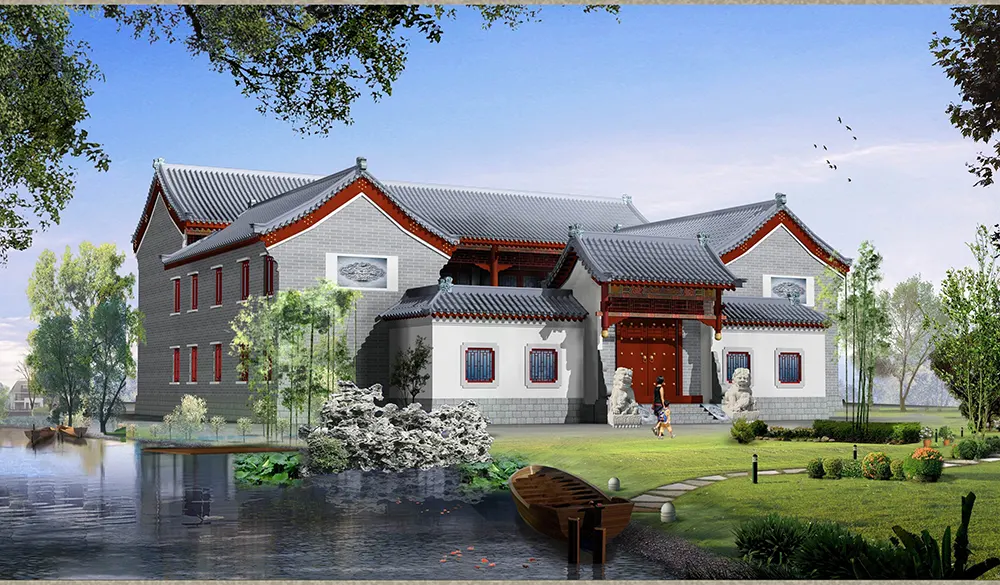
In recent years, a new favorite has emerged in the field of rural self-constructed houses in China, where the steel mesh composite concrete wall stands out with its groundbreaking design. Breaking through the performance limitations of traditional walls, this wall type boasts the combined advantages of structural stability, thermal insulation, soundproofing, cost savings and rapid construction. As a cast-in-place wall, it allows for easy pre-installation of pipelines and integration with systems like PLC, making it the optimal solution for modern smart homes.
This construction method features flexible design and transparent house-building costs, which can save a significant amount of later-stage decoration expenses. It provides excellent support for various construction schemes, ranging from high-end smart villas with modern rustic home decor to low-cost options such as sustainable farmhouses, low-cost village houses and passive houses.
In addition, since standard steel mesh for walls (e.g., 240mm-thick walls) can be prefabricated and walls assembled on-site, it falls into the category of prefabricated buildings, and the work can be competently performed by ordinary construction workers. Home builders can well organize flow construction to greatly improve work efficiency; combined with low-cost concrete pumps, walls can be poured in one go, which significantly accelerates the house construction speed.
一、 Efficient and Convenient Construction, Ideal for Organization by Home Builders
- Easy and Effortless Steel Mesh Assembly: Factory-prefabricated components allow on-site splicing of double-layer steel mesh with built-in fire-resistant insulation boards only. The structure is fixed through and through with metal tie bars, featuring high precision and fast speed, without the need for complicated cutting or adjustment. The construction can be completed by ordinary workers, eliminating the reliance on a large number of master craftsmen. For cast-in-place concrete walls, there is no need for labor costs incurred by formwork erection and removal, with all expenses invested in the main structure of the house.
- Reliable Fixing and Reinforcement: The steel mesh cavity is firmly fixed to structural columns, ring beams or steel structural frames with an overlap width of ≥100mm. It will not loosen or deform during pouring, thus ensuring construction quality.
- Efficient and Hassle-free Concrete Pouring: Self-compacting fine aggregate concrete is poured in layers. The large mesh holes of the outer steel mesh facilitate slurry penetration and bonding, while the dense mesh holes of the inner steel mesh ensure concrete compactness. No additional vibration is required, and the naturally rough wall surface is easy for subsequent decoration.
- Simple and Efficient Finishing: The exterior wall adopts a combination of fiberglass mesh, anti-crack mortar and weather-resistant coating/real stone paint for moisture and corrosion resistance. The interior wall can be directly plastered and painted. Compared with traditional brick walls, the construction period is shortened by more than 30%, and as an assembly-type construction method, labor costs are reduced by over 50%.
二、 Diverse Wall Specifications to Meet Full-scenario Requirements
- According to different structures and climates, there are various configuration schemes for exterior walls.
- Flexible Exterior Wall Thickness: Customizable from 150mm to 300mm. The standard 240mm thickness balances performance and cost efficiency, while the thickness can be increased to 300mm in severely cold regions to enhance thermal insulation.
- Thoughtfully Designed Double-layer Hot-dip Galvanized Steel Mesh: The outer mesh, made of 1.0–2mm thick steel wires with 50×50mm or 80–100mm large apertures, forms a robust load-bearing framework for the wall, maximizing its deformation and impact resistance. The inner mesh, constructed with 0.3–0.6mm fine wires and 1–3mm dense apertures, precisely blocks concrete aggregates while allowing water to seep out naturally. This ensures the poured wall is dense and free of honeycombing defects. The inherent rough texture of the wall surface also eliminates the need for roughening procedures, simplifying subsequent decoration work.
- Built-in Grade A1 Fire-resistant Insulation Board: With a thickness of 50–150mm and a density of 100–150kg/m³, the board integrates thermal insulation and fire protection in one step. Boasting a thermal conductivity coefficient of ≤0.04W/(m·K), it locks in heat in winter and blocks heat penetration in summer, resolving the issue of significant indoor temperature fluctuations and greatly improving residential comfort.
- Interior wall configurations prioritize practicality and sound insulation.
- Optional Interior Wall Thickness: Ranging from 100mm to 200mm, with 120mm and 150mm as the most commonly adopted specifications. This design saves indoor space and enables more flexible layout planning.
- Durable Hot-dip Galvanized Steel Mesh (Same Material): The outer mesh, featuring 1.0–1.5mm wire diameter and 50×50mm apertures, ensures structural stability, while the inner fine-mesh layer (0.3–0.5mm wire diameter) prevents concrete slurry leakage. A 20–50mm fire-resistant sound insulation board (with a sound insulation capacity of ≥38dB) can be embedded as needed to isolate indoor and outdoor noise, creating a quiet living environment. For scenarios without sound insulation requirements, the configuration can be simplified to balance practicality and cost-effectiveness.
- Uncompromising Commitment to Structural Safety
- Brick-concrete-like System: 250×250mm structural columns are installed at wall corners and junctions, and 300mm-high ring beams are arranged on each floor. The enclosed connection enhances the overall integrity of the structure, making it suitable for low-to-mid-rise buildings. It delivers higher stability than traditional brick-concrete structures while being significantly lighter.
- Frame System: When paired with Q235B/Q355B grade steel structural beams and columns, S-shaped tie bars tightly connect the walls to the frame. Reinforced steel mesh is added around door and window openings, enabling the structure to achieve a seismic resistance grade of 6–8. This ensures calm response to natural hazards and provides a strong sense of residential safety.
三、 Precisely Addressing the Pain Points of Traditional House Construction
- Sturdy and Durable, for Total Peace of MindThe outer mesh made of thick steel wires forms a robust framework, while the inner mesh of fine steel wires ensures concrete density. Integrated seamlessly with concrete and rock wool boards, the wall delivers far superior crack and impermeability resistance compared with traditional wall structures. The hot-dip galvanized material provides excellent rust and corrosion protection. Combined with reinforced structural design, it boasts a service life of over 40 years with almost zero maintenance costs in the later stage. A single construction ensures long-term hassle-free use.
- Energy-efficient and Comfortable, for a Pleasant Living ExperienceThe exterior wall is built-in with rock wool boards for thermal insulation, maintaining a stable indoor temperature, significantly reducing energy consumption, and keeping the interior warm in winter and cool in summer while cutting down electricity bills. The interior wall can be optionally equipped with sound insulation components to block external noise and create a quiet living environment. It adapts to different climatic conditions and residential needs, making the residence both practical and comfortable.
- Flexible and Adaptable, for Full-scenario CoverageThickness, thermal insulation and sound insulation performance can all be customized on demand, suitable for diverse climates such as severely cold and hot-humid areas. It is compatible with two structural systems: brick-concrete-like system and frame system, and fully applicable to low-to-mid-rise residential buildings and small public buildings. Regardless of regional differences and varied requirements, it can achieve precise matching.
- Cost-effective, for Better Cost ControlEliminating the need for wooden formwork reduces material waste, and significantly cuts down labor and construction period costs. The materials are affordable and readily available. The overall construction cost is much lower than that of traditional wall structures. You can obtain a building wall with better performance at a lower cost, and the cost-effectiveness advantage is self-evident.
Dear readers, for inquiries about the process parameters and construction schemes of formwork-free steel mesh concrete walls, as well as the design schemes for sustainable farmhouses, low-cost village houses and passive houses, feel free to contact me! My WhatsApp number is 852-98834462.